When Aphrodite Cucked Hephaestus
Hephaestus is a guy stuck in his head

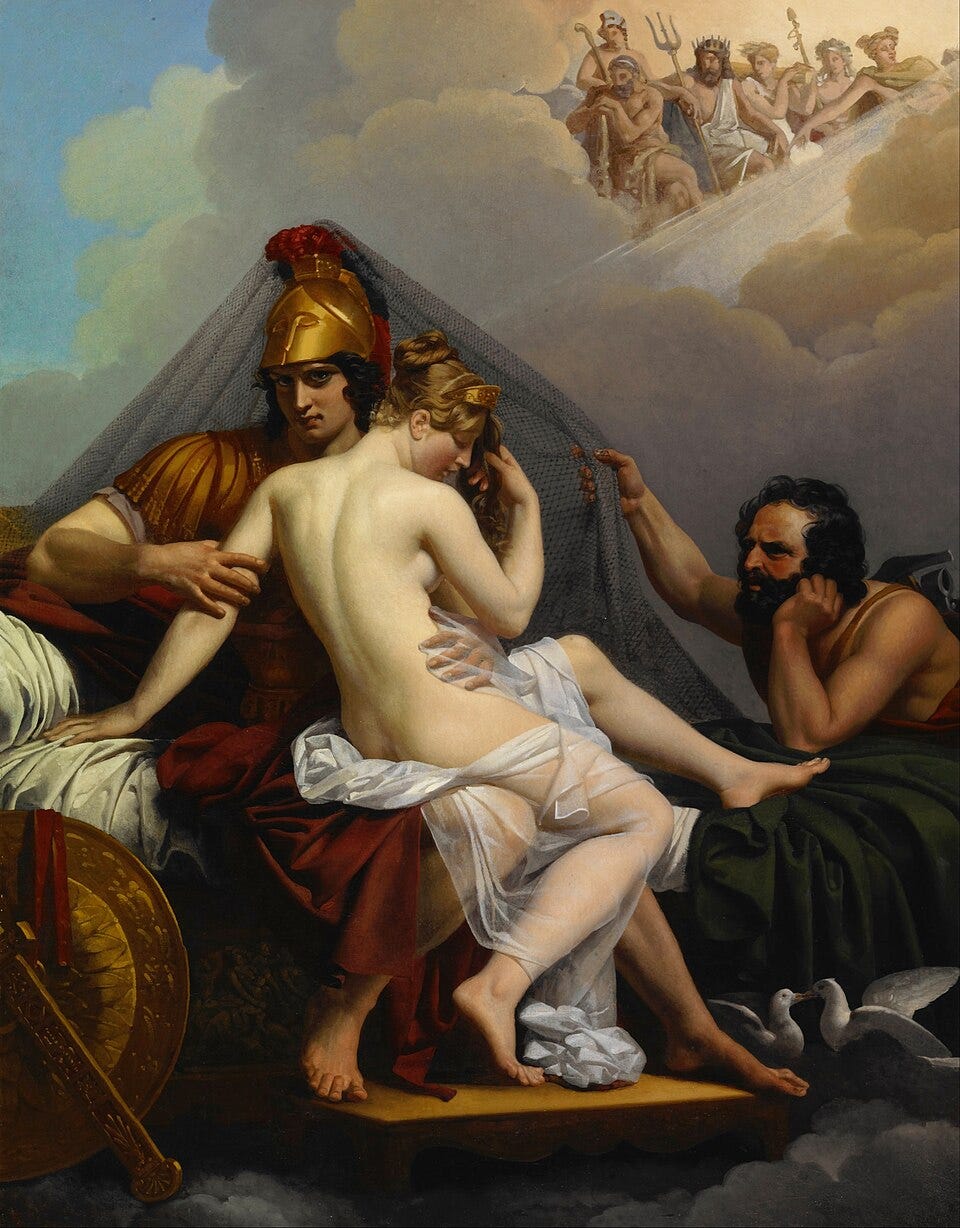
The look on Hephaestus’ face in the painting attached speaks volumes, He’s very invested in the outcome of this event, rather than just laughing it off and chalking up the loss as part of the game. It was a marriage literally founded on an obligation anyway.
(Painting by, Alexandre-Charles Guillemot: ‘Mars and Venus Surprised by Vulcan’)
This myth is more of a humorous one, but full of very relatable metaphors that we’ll get into later.
The main protagonist of this myth, Hephaestus, is an often overlooked god because he’s content in himself and likes to keep his head down as the master blacksmith that he is.
Before we get into the myth itself, I’ll explain a bit of the background of Hephaestus and how he’s kind of like a modern day provider guy, who is an expert at his craft but isn’t particularly exciting to women.
From birth he had a terrible start. He was the son of Zeus and Hera, but he was born slightly disfigured and ugly looking, so Hera literally threw him from Mount Olympus in disgust.
The immense fall took him a full day before he crashed to Earth and broke his legs, leaving him with a permanent hobble.
To make a long story short, he spent his time on Earth mastering his craft of blacksmithing. It was only when he had quietly mastered this craft that he used his skills to get some revenge on his mother and elbow his way back onto Mount Olympus.
Later on he would marry the goddess of desire, but it was an arranged and politically motivated marriage with no attraction or genuine desire involved for Aphrodite, who hated the look of Hephaestus.
But Hephaestus was smitten with Aphrodite’s immense beauty and would craft her all kinds of beautiful gifts, so it was slightly similar to how in our age, some attractive party girl eventually gets herself a stable, loving provider husband but doesn’t truly crave him.
He likes her more than she likes him, which never ends well.
The Myth Itself...
Aphrodite was holding a bouquet of crimson red flowers in her hands, handpicked by her secret lover, Ares.
These were nothing special but they meant so much to her.
At her feet, which she had dropped with indifference, was the most elaborately forged gold necklace that her husband Hephaestus had spent months crafting for her.
But it meant nothing to her, as she had no real love for him.
In Aphrodite’s eyes, her husband Hephaestus was not only ugly but he was simply neutral, plain, boring, or what we might call ‘vanilla’ in our age.
She felt almost nothing for him, besides a mild level of disgust at his appearance.
Ares however, made her feel electric, as though they were made for each other. They were complimentary opposites after all.
Aphrodite perfectly summing up raw femininity, and Ares perfectly summing up brutal masculinity.
She had been cheating on Hephaestus with Ares since the very start of their marriage, but one day Helios, the god of the sun, spotted the cheaters at it in Hephaestus and Aphrodite’s bed.
Helios was quick to let Hephaestus know about it, but Hephaestus, though enraged, didn’t directly confront Aphrodite about it.
Instead he made a plan…
He set to work making an extremely fine and delicate net made of bronze metal in his workshop, that he planned to capture the cheaters with.
Once he had spent days creating this net, he told Aphrodite that he was going away on a trip for a couple of weeks, to fool her into a false sense of security.
Hephaestus had rigged his almost invisible bronze net above their marriage bed, knowing that is where they do their cheating business.
Within an hour of him pretending to leave, Aphrodite and Ares were naked and all over each other in the bed.
Sitting in the cupboard, peaking through a gap in the door, (in true cuck fashion) Hephaestus triggered his trap and the net ensnared the cheaters, leaving them unable to move.
Rather than confront them directly, now that he has the chance, he instead gets all of the gods to come over to his palace to see firsthand the cheaters trapped in his net.
He starts demanding some form of compensation or justice for the breaking of her wedding vows, but all of the gods just laugh. Not only at Hephaestus, but at Ares and Aphrodite as well.
Poseidon eventually offered to pay some kind of fine on behalf of Ares if he just let them go, and Hephaestus agreed, but he was done with the marriage and Aphrodite.
After the events, Ares went away to spend some time in his homeland to get over the shame of being caught.
Aphrodite went to bathe in the sea to clean herself and renew her virginity, after the chaos that had just ensued.
The cheaters did later reunite and had multiple children together. The most famous 3 being 2 called Phobos and Deimos (Fear and Terror, moons of the planet Mars/Ares) and 1 called Harmonia, the goddess of harmony.
But even years later they hadn’t outrun the damage they had done with their cheating, as Hephaestus, still bitter, crafted Harmonia a cursed necklace that brought constant misfortune to anyone who possessed it.
Let’s dive into the metaphors being communicated here…
Aphrodite being the goddess of love, desire, and beauty perfectly compliments the very masculine Ares, who is the god of brutal warfare, blood-lust, and violence.
Like magnets it was inevitable that these two would eventually get together, and you can see this play out in our world with highly polarised couples.
Her marriage to Hephaestus was purely out of obligation which means it was 100% doomed to fail in some fashion.
What keeps a couple together is an invisible kind of electromagnetism that is fueled by the opposing sexual energies. The more watered down those energies are, the less attraction there will be.
The next interesting metaphor I see is that technology can temporarily restrain chaos (the bronze net capturing the cheaters) but it can’t prevent nature from taking its course eventually. This implies that man can tinker with the world but nature has the ultimate say.
The fact that Hephaestus avoided confronting them directly and instead invested his time into creating a trap, is a metaphor for not letting go of things quickly and how this is pointless.
In the end, he may have trapped the two of them, but it ended in laughter and a small compensation payment, when he could have quickly moved on in life.
But on the flip side, it also displays how the need for revenge can be used as a motivational fuel source in life.
This may seem ‘good’ but once you’re aware that you’re motivated by revenge, it loses its power, it’s most effective when used subconsciously. Once you’re smart enough to see your own game, you have to let revenge go and focus on moving forward. That’s the message I’m getting here.
Shit happens and life quickly goes on. Only Hephaestus truly cared about what went down, and after about 5 minutes, the other gods were thinking about when they would next eat ambrosia, or go down to Earth to meddle in human affairs. They quickly forgot about the drama. But Hephaestus being someone who is stuck in their head is prone to overthink the situation and heavily plan for the future in order to keep the illusion of full control going.
Another metaphor in this myth is that civilization and primitive instincts are always clashing in this world, and will continue to do so forever.
Their marriage represents civilization, and the adultery represents primitive instincts constantly chipping away at the perceived order of things. Like a small blade of grass slowly growing through a highway, eventually destroying the road if not dealt with.
All forms of ‘order’ need to be maintained or they will succumb to entropy, as everything wants to break down to base material. It’s only humans who have the ability to refine, and elevate base material into something exceptional and extraordinary.
Hephaestus is like the logical provider husband who expects his wife to always be into him because they are now married, but this myth emphasises that it is an emotional charge that maintains a woman’s interest in a man, not a rational one.
It seems as though Hephaestus never learns this lesson, as years later he curses Aphrodite and Ares’ daughter with a corrupted necklace. He continues to view male-female relationships as a logical exchange rather than an energetic/emotional one.
If I had to sum up this myth with just one metaphor, it would be that raw desire conquers all in the world of relationships. Without that electric emotional energy from the clash of masculine and feminine personalities, there is no true romantic connection.
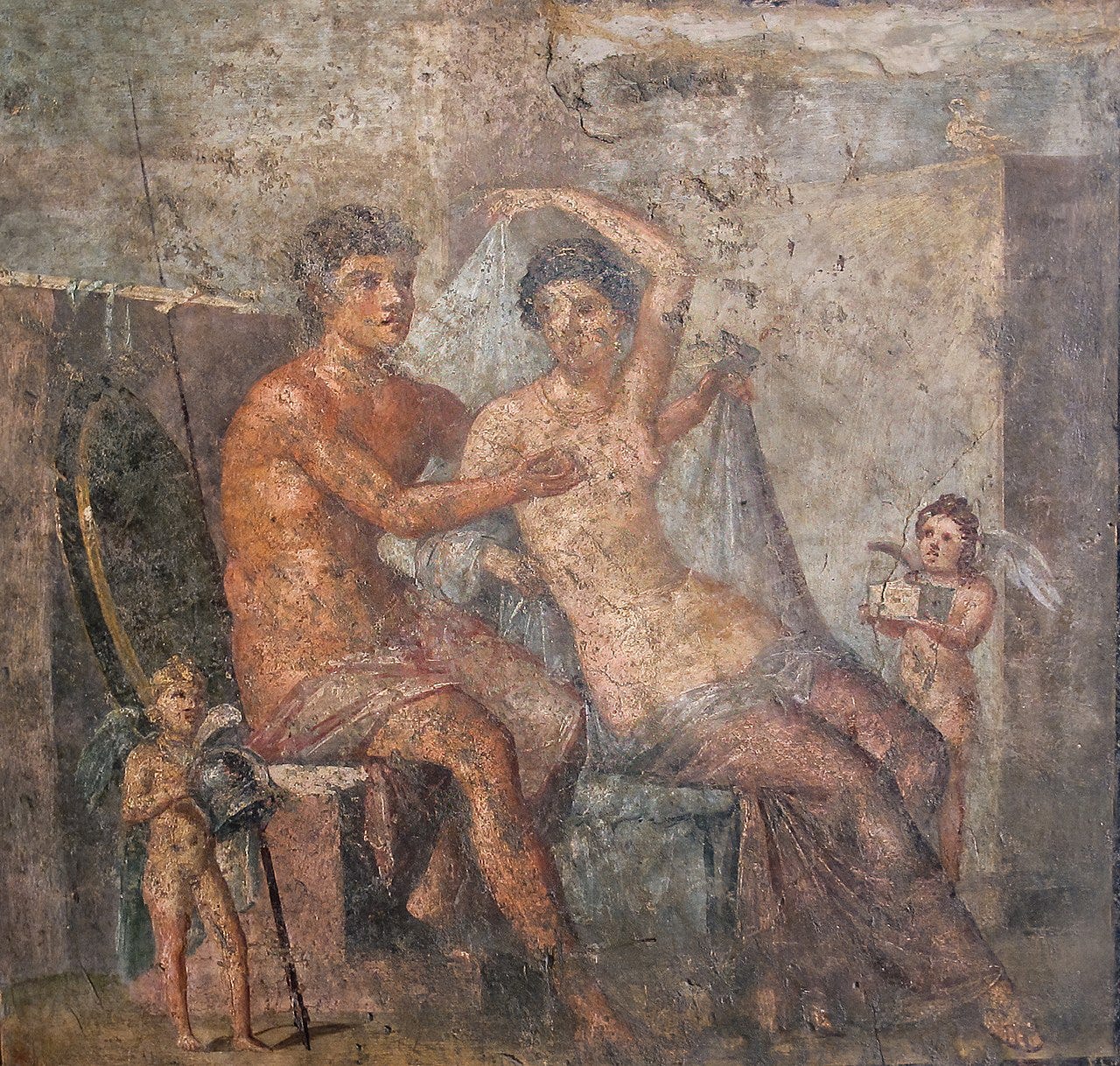
This is a fresco from Pompeii, showing Mars and Venus ‘warming up’. (Mars and Venus being their Roman names)
My upcoming project is going to be packed with all kinds of mythological and historical breakdowns like this, be sure to follow me here on Substack so I can tell you about it when it’s ready.
Thanks for reading.
Arthur.